



Chi tiết tin - Quang Tri Portal

The cotton tree in my village
In mid-August 2024, I received a phone call from Mr. Ho Duy Thien, former Chairman of the People's Committee of Tuyen Hoa district, former Quang Binh province: "On August 22, Thach Hoa commune will hold a ceremony to announce the decision to recognize the new rural commune and receive a certificate recognizing the ancient cotton tree in Thiet Son village 3 as a "Vietnam Heritage Tree". Please arrange to attend!".
Since his retirement, Mr. Ho Duy Thien was elected as Chairman of the District Cultural Heritage Association. He is an active and enthusiastic person in collecting, investigating... then inviting experts to survey, prepare scientific documents to submit to competent authorities, so that by the end of 2023, the kapok tree in Thiet Son village 3 will be recognized as a "Vietnam Heritage Tree". This is the first and only "Vietnam Heritage Tree" of Quang Binh province (old), now Quang Tri province. Needless to say, Mr. Thien was excited when he announced this good news to me.
As for me, more than joy, a feeling of emotion welled up. Suddenly, in my mind appeared the ancient, solemn cotton tree, towering in a corner of the sky, like a piece of the village soul shimmering in the sun and moon, like a witness of the beloved village for generations...
Thiet Son is a small village on the banks of the Gianh River, where I was born and raised. When I was a little kid, I saw a kapok tree standing there. My grandparents also said that since they were little, they had seen the kapok tree like that, with a tall, straight trunk, about fifty meters tall. From the beginning of the village looking up, from the end of the village looking down, in every season you could clearly see the kapok tree, sometimes with green leaves and branches, sometimes with countless fire buds, sometimes bare and cold in the storm. The kapok tree trunk was very big, rough with knots and bumps of all strange shapes. I heard that when the Kapok tree was built, nearly ten young men from the irrigation team had to stretch their arms in a circle to hug the tree trunk…
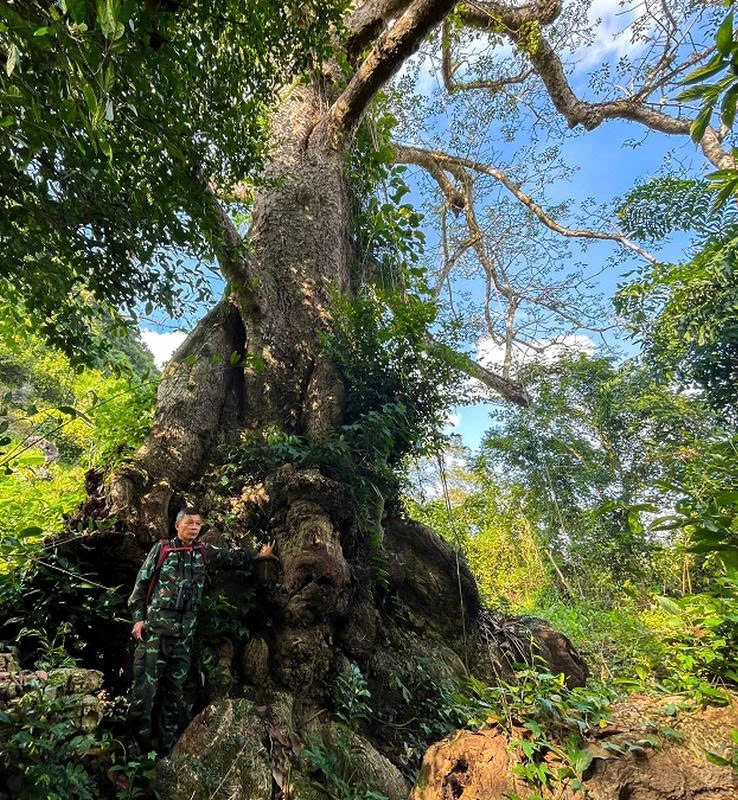
The rice roots are rough with strange bumps - Photo: Provided by the Heritage Association
“Mang Cay Gao” is a new name that has been around for about sixty years, since the cooperative built a wooden trough more than thirty meters long across Khe Mon, passing through the kapok tree, bringing water to the fields of Trot Can, Ma Hang, Da Lo, Loi Soi… During the renovation period, the rotten wooden trough was replaced with sturdy concrete, but still named “Mang Cay Gao”. During the fieldwork to evaluate the dossier of “Vietnam Heritage Tree”, scientists estimated that the kapok tree was about 300 years old, but the village elders said that it must be at least 400 years old.
According to the family genealogy, my village was formed about 400 years ago. When the residents from the Lower region went up the Gianh River here to reclaim land, there was definitely a cotton tree standing at the foot of the limestone mountain, towering like a giant screen covering a flat area, so that mountain was called the Cotton Tree Cliff.
My childhood has many memories associated with the old, rough cotton tree, cutting grass in the fields, herding buffaloes, catching crabs and snails. Next to the cotton tree is the deserted, mossy Me Son temple, occasionally there are a few flickering incense sticks from someone secretly. The cotton tree and the temple are a whole mysterious world with ghost stories that adults often tell to scare naughty children who climb up and down.
Not only children, but also adults rarely dare to cross fields and wade streams alone at night past this cotton tree. Only when American planes bombed the railway section west of Cay Gao, at night the area around Me Son temple and the cotton tree was bustling with people. Those were the uncles and aunts of the youth volunteer unit, all from Zone 3, stationed in my village to protect the above railway section. During the day, the uncles and aunts studied culture and practiced performing arts, at night the unit divided into 2 shifts to fill bomb craters, the cotton tree became the gathering point for shift change. Many days, this place was the gathering point for first aid for wounded soldiers and burial of martyrs...
I graduated from high school when the war against America had just ended, but not long after, guns started to fire at both ends of the country. That year, during the season of the cotton tree, I enlisted in the army, sending back to my homeland a poem with the image of the beloved cotton tree:
“Hello, the years not far away
Kapok flowers bloom in the fields in the scorching midday sun
The water of Khe Mon stream has been flowing for thousands of years.
Listless…
The old cotton tree is pensive.
Skinny body, can not produce rice
Dry Plains, Ma Hang
Stone Field, Gravel Path
The names are barren, dry…”
The war brought me to many rural areas of the country. I just realized that the po-lang tree in the Central Highlands and the cotton tree along the northern border are also the cotton tree of my hometown... Po-lang flowers on the plateau are the soul of the lyrical and tragic epics of the Ba-na, E-de, and M'nong ethnic groups... The cotton tree along the northern border are steadfast milestones protecting the border. As for the cotton tree in my hometown, simple and rustic as its name, it is the aspiration for prosperity passed down from generation to generation of the village like many other villages in the Central region, facing harsh weather and sun...
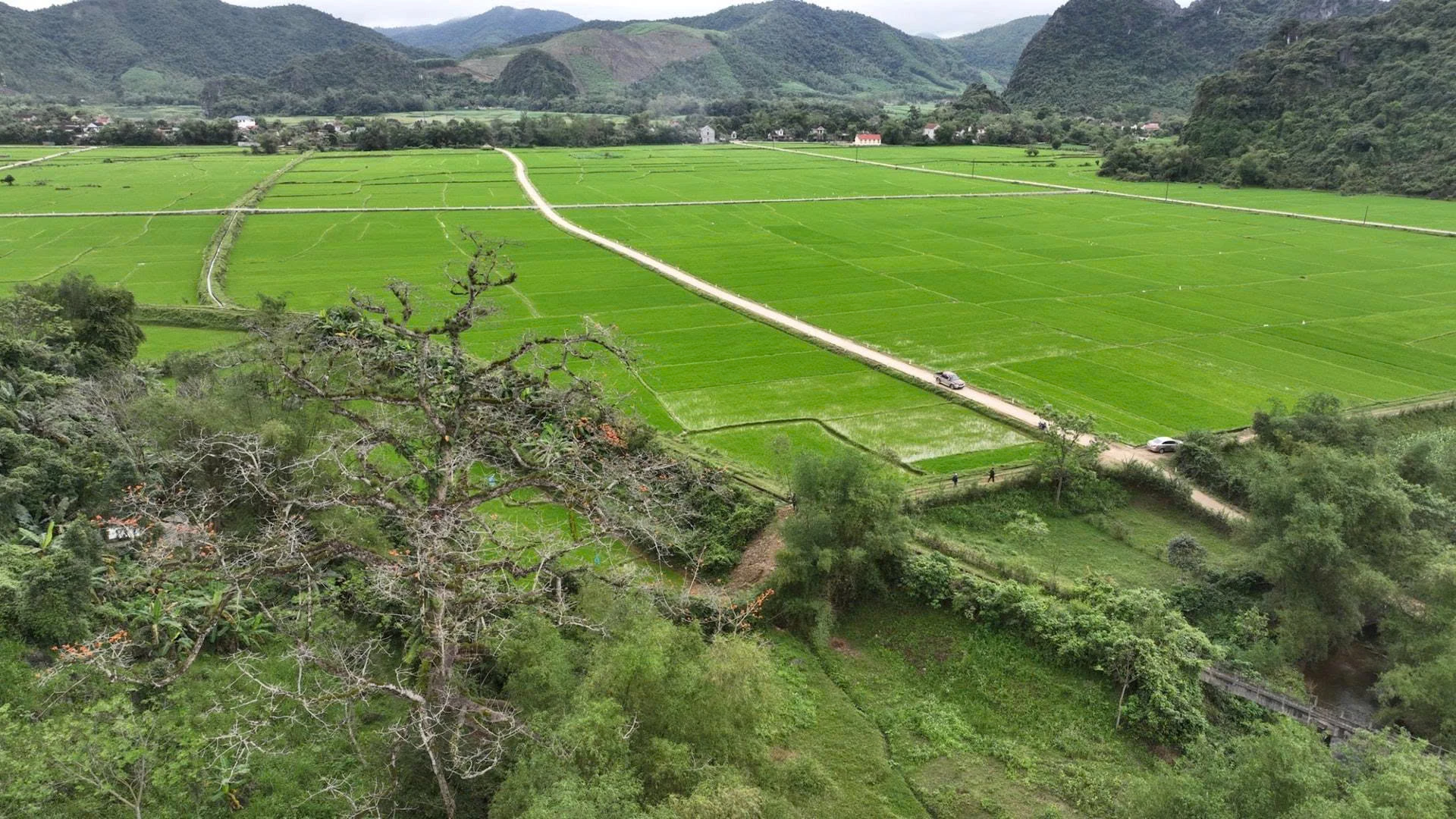
Kapok tree next to the village field - Photo: Provided by Heritage Association
During the resistance war against the French colonialists, my village was the gateway to the Dong Lao War Zone - the "Safe Zone" of Quang Binh province. Then, during the years of "cutting through Truong Son to save the country", my village became a stopover for soldiers "going to Be", year after year. The Chua cave, Diem cave, Ca cave, Mu Lai cave... became logistics warehouses, weapons warehouses... for soldiers and classrooms for children.
Recently, during a field survey to evaluate the dossier of “Vietnam Heritage Trees”, scientists discovered traces of ancient people and paleontological fossils in Chua cave, showing that prehistoric people had appeared in this land. Especially recently, the white-cheeked langurs have reappeared in Cay Gao cliff. This is one of the primate species classified as critically endangered in the Vietnam Red Book.
Currently, my village is located in the National White-cheeked Langur Conservation Area, covering more than 500 hectares in 4 communes upstream of Gianh River in the Dong Lao War Zone during the resistance war against France.
The return of the rare primates has made the Cay Gao cliffs bustling. The kapok tree at the foot of the cliff has become a “meeting point” between the villagers and the white-cheeked langurs. It seems that they know they are being pampered, so they are becoming more and more bold and friendly towards humans. On nice days, they come out to play on the kapok tree branches, “posing” for amateur and professional photographers from near and far who are increasingly coming to my village. Occasionally, there are even foreigners who come by car to admire the white-cheeked langurs, take pictures, take notes and nod to each other with satisfaction…
The white-cheeked langurs and the “Vietnam Heritage Kapok Tree” are promising to “bring” to my village feasible projects from travel agencies inside and outside the province, aiming to promote the value of cultural relics, resistance history and the ecosystem of a charming mountainous countryside. And the Kapok tree in my village will certainly be an attractive and unique tourism product, contributing to making more and more “rice” for my villagers in the future…
Souce: https://www.vietnam.vn/
- Exchange of folk culture clubs (18/09/2025)
- "Green Connection Journey": Quang Tri - coastal villages (12/09/2025)
- General Vo Nguyen Giap Memorial House - A place to preseve national pride (24/03/2025)
- Visit Hundred-Year-Old Traditional Craft Villages In Quang Binh (07/11/2024)
- Nhan Trach fishing village, Quang Binh (06/08/2024)
- Unique craft of conical hat making in Ba Don - Quang Binh (08/05/2024)
- Rice paper making under scorching central Vietnam sun (25/03/2024)
- Mural village woos more visitors to Quang Binh (19/03/2024)
- Quang Thuan Conical Hat Village (22/04/2014)
- An Xa Sedge Mat Village (22/04/2014)


