



Chi tiết tin - Quang Tri Portal

Rare Himalayan sapria discovered in Phong Nha – Ke Bang forest
The discovery provides additional scientific data on the region’s flora and suggests that the limestone forest ecosystem in the national park remains well preserved.
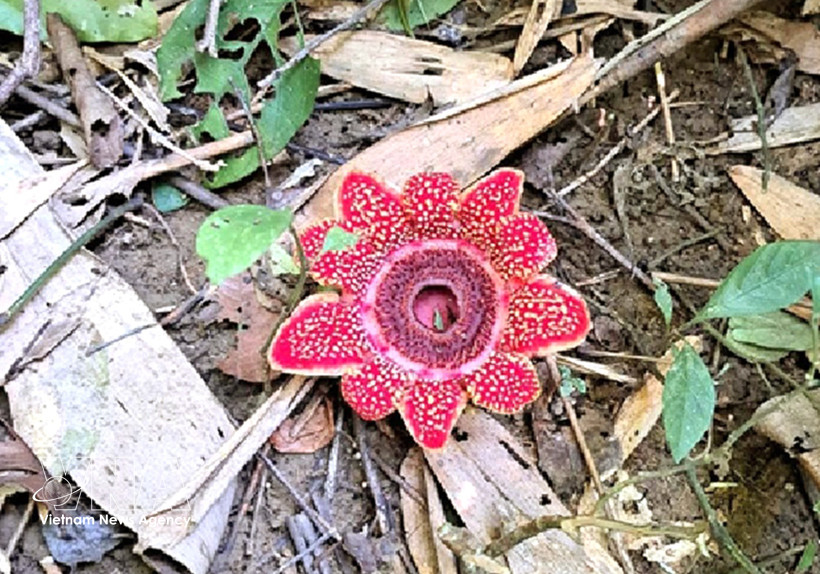
The Himalayan sapria found in the Phong Nha - Ke Bang National Park (Photo published by VNA)
A rare parasitic plant species, the Himalayan sapria (Sapria himalayana), has been recorded in the Phong Nha – Ke Bang National Park, according to the park’s management board.
The species was found in Sub-zone 649 within a strictly protected area managed by the Con Roang Forest Protection Station.
Himalayan sapria belongs to the Rafflesiaceae family, a group of plants known for their unusually large and distinctive flowers. The discovery provides additional scientific data on the region’s flora and suggests that the limestone forest ecosystem in the national park remains well preserved.
Researchers say the Himalayan sapria is a fully parasitic plant that lacks chlorophyll, leaves or true stems for photosynthesis. Its vegetative body is highly reduced and survives by attaching to the roots of host plants to absorb water and nutrients.
At the site in Sub-zone 649, the plant was found parasitising woody climbing vines of the Tetrastigma genus in the grape family. The flower is the only part of the plant that emerges above the ground for reproduction.
Recorded specimens have a diameter of about 15–20 cm, with dark red petals dotted with pale yellow spots. The flowers emit a smell similar to decaying meat to attract pollinating insects, mainly flies belonging to the Diptera order.
Experts note that the Himalayan sapria has a very narrow ecological range and is highly sensitive to changes in soil conditions, humidity and forest canopy structure. It typically occurs only under dense evergreen tropical rainforest where thick layers of leaf litter, high canopy cover and minimal human disturbance are present.
In both the Vietnam Red Data Book and the Red List of the International Union for Conservation of Nature, the Himalayan sapria is classified as endangered due to its limited distribution and complete dependence on host plants.
According to the park’s management board, the discovery raises the total number of plant species recorded in the Phong Nha – Ke Bang National Park to 2,957, further affirming the site as one of the most important biodiversity centres in Vietnam and the region./.
Source: VNA
- Lanterns of gratitude light up Thach Han River (11/03/2026)
- Quang Tri hands over rare otter to Cuc Phuong National Park (04/03/2026)
- Binh Ngo Spring Press Festival 2026 spreads the spirit of sharing and giving gifts to poor students in Quang Tri (23/02/2026)
- Over-226kg bomb safely defused in Quang Tri province (25/02/2026)
- Keeping folk melodies alive amid Truong Son mountains (27/01/2026)
- Phong Nha - Ke Bang builds dossier to nominate for the 3rd World Heritage Site (17/01/2026)
- US C-119 transport aircraft brought for display at Ta Con airport (15/01/2026)
- People voluntarily hand over rare mountain-side turtles (10/01/2026)
- Rare red-faced monkey strays into people's house (10/01/2026)
- Wildlife rescue in Phong Nha - Ke Bang and the conservation problem (10/01/2026)


