



Chi tiết tin - Quang Tri Portal

When the 'steel island' turns to tourism - Final part: A 'beyond-the-framework' mechanism is needed for a breakthrough
During his visit and survey of Con Co Island in October 2024, General Secretary and President To Lam emphasized a major direction: to develop this strategically important island into a tourism and service center, serving as a solid outpost in the East Sea.

General Secretary and President To Lam speaks at a working session with the Party Committee, government, and armed forces of Con Co island district, Quang Tri province, in October 2024. Photo: Lam Khanh/VNA
This directive is strategic, but it also raises a difficult question: How can a small island, once a "steel island" during the war, transform itself into a world-class destination while preserving its core values? At present, the answer is becoming clearer: the opportunity exists, the potential has been identified, but to achieve a breakthrough, what is missing – and crucial – is a mechanism strong enough, distinctive enough, and open enough to allow Con Co Island to forge its own path. VNA presents the final article in the series "When the 'steel island' develops tourism ".
Developing Con Co Island into a tourism center
On the map of Vietnam's coastal and island tourism, it's easy to name established destinations like Phu Quoc or Con Dao. Compared to those names, Con Co Island stands out with a different image – smaller, quieter, but also with more constraints.
An island measuring just over 2.3 km², with most of its area covered in natural forest and a vulnerable ecosystem. Above all, it's a strategic outpost – where every development decision is not simply an economic calculation, but must always be considered in close relation to national defense and security. These factors prevent Con Co Island from following the familiar path of other coastal tourism centers: rapid expansion, dense construction, and large-scale visitor arrivals. For this island, development – if any – must be a carefully considered process, even a "slow but steady" approach.

The goal is to develop Con Co Island into a tourism and service center, while maintaining its role as a strong outpost at sea. (Photo: VNA)
A crucial foundation for this direction was clearly established during the visit of General Secretary and President To Lam on October 16, 2024. Amidst the pristine seascape, the head of the Party and State not only expressed his admiration for the rare natural beauty of Con Co Island, but also emphasized the island's special strategic position within the overall national maritime strategy. In particular, the direction set forth was inseparable from two elements: development and protection.
The General Secretary and President requested that Quang Tri province develop Con Co Island into a tourism and service center, linked to its role as a forward outpost in the East Sea; and at the same time, build a solid defense area, ensuring political security and social order, creating a stable foundation for socio-economic development. The General Secretary and President called on businesses, investors, and management agencies to participate in the development process.

The pristine natural landscape and rich, glorious history are creating a unique appeal for the Con Co Special Economic Zone, making it an increasingly attractive destination for tourists. Photo: Nguyen Linh/TTXVN
According to Mr. Ho Van Hoan, Deputy Director of the Department of Culture, Sports and Tourism of Quang Tri province, these strategic directives are gradually being concretized into a policy foundation – a "pillar" for the locality to build specific mechanisms suitable to the unique conditions of the island.
From a management perspective, Mr. Ho Van Hoan believes that Con Co Island needs to be developed according to a high-quality, small-scale, and controlled ecological model. If exploitation is limited to the more than 2.3 km² of land, the island could easily become overloaded – a situation that has occurred with many other destinations. Therefore, expanding the development space to the sea – a protected area of over 4,500 hectares – is considered the inevitable direction. But more importantly, it's no longer about geographical expansion, but about an expansion in development thinking: from "exploitation on the island" to "sustainable, holistic exploitation of the island and sea space."
Positioning itself as a "green, pristine, and unique island."
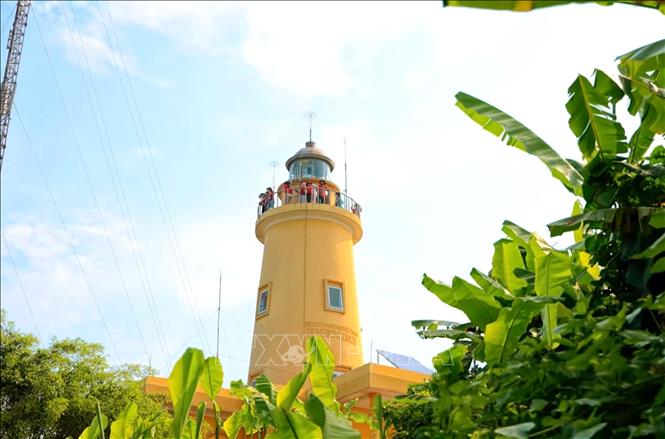
Tourists enjoy admiring the panoramic view of Con Co Island from the top of the lighthouse, which offers a sweeping view of the open sea. Photo: Nguyen Linh/TTXVN
From those guidelines, a "identity" for Con Co Island gradually took shape: a green, pristine island offering unique experiences. This is not a slogan; it's a calculated choice. An island formed from ancient volcanoes, once a "battleground" during the war, yet today it retains its forest and marine ecosystem almost completely intact. This pristine state is both an advantage and a limitation; it allows for differentiation but also demands caution in every step of development.
According to Pham Hai Quynh, Director of the Asian Tourism Development Institute, Con Co Island's greatest strength lies in the rare interplay between history and nature. He explained: "This is not just an ecological island, but also a symbol of sovereignty – a 'steel fortress' during the war. The combination of historical and spiritual tourism with forest and marine ecotourism creates a unique identity. In a context where many island destinations are becoming increasingly similar, 'difference' is no longer an advantage, but a matter of survival. Con Co has the foundation to create that difference. But as experts point out, the problem lies not in the potential – but in how it is exploited. Currently, Con Co has not yet attracted strategic investors. The reason is not necessarily a lack of interest, but because the mechanisms are not attractive enough to compensate for the disadvantages in location, scale, and infrastructure."
According to Mr. Pham Hai Quynh, instead of scattered development, Con Co Island needs a symbolic "boost"—for example, a high-end resort of appropriate scale to establish its brand. But to achieve that "boost," policies must precede it. This includes high investment incentives for ecotourism and green infrastructure, extended land lease periods, and reduced initial costs; as well as strong reforms of administrative procedures, especially for projects with defense and security implications. Another noteworthy approach is piloting a "sandbox" mechanism for green tourism—allowing the testing of new models such as night-time economy, marine sports linked to conservation, or zero-emission transportation. International experience shows that many small islands have succeeded in this direction—from the "zero-waste" model in Kamikatsu (Japan) to marine protected areas like the Great Barrier Reef (Australia). Of course, the important thing is not to copy, but to select and adapt to suit the actual conditions.
Mr. Duong Ba Hung, General Director of Top Ten Travel Company, believes that businesses are ready to participate in controlled tourism models. Limiting the number of tourists and strict environmental standards are not barriers but rather help enhance the value of destinations. Businesses need a stable and transparent investment environment for long-term development.
Mechanisms – the “key” to development

The artificial freshwater lake in the Con Co Special Economic Zone contributes to ensuring water supply for daily life and services, gradually reducing the pressure of freshwater shortage – one of the major bottlenecks for economic and tourism development on the island. Photo: Nguyen Linh/TTXVN
Looking back at the reality of tourism development in Vietnam, one common point can be seen: localities that have achieved breakthroughs are all linked to superior mechanisms. For Con Co Island, this need is even more urgent. This is because it is not only a tourist destination, but also a strategic outpost – where all development policies must take into account the unique factors of national defense and security. Approaching it with conventional mechanisms would make it very difficult to create a truly breakthrough.
According to Ho Van Hoan, Deputy Director of the Department of Culture, Sports and Tourism of Quang Tri province, the province is developing a tourism development plan for the period 2026-2030, emphasizing the formation of sufficiently strong incentive mechanisms to attract investment. Simultaneously, the "Project to develop the Con Co Special Economic Zone into a strong economic and secure zone" has been approved by the Provincial Party Standing Committee and is being submitted to the Prime Minister for approval. This project includes many specific policies such as: supporting 30-50% of shared infrastructure costs; exempting corporate income tax for the first four years and reducing it by 50% for the following nine years; exempting or reducing land and water surface lease fees; and applying a one-stop mechanism to shorten licensing times. These are the first steps, laying the foundation for a new direction of development. However, to create a real "breakthrough," experts believe that stronger, more flexible, and more experimental mechanisms are still needed – mechanisms that are suitable for the unique characteristics of a small but strategically important frontier island.
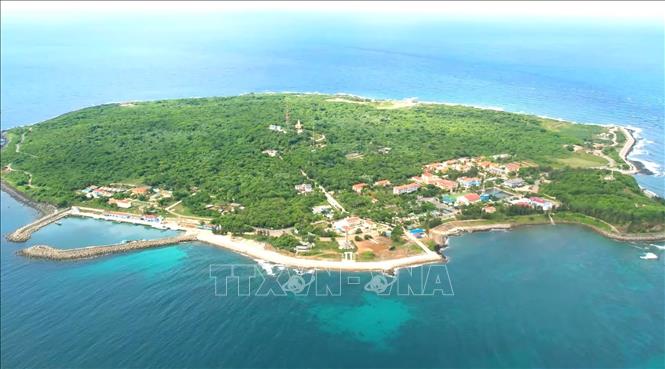
Con Co Island is positioning itself for tourism development as a "green island - pristine - unique experience," creating a distinct mark on the map of island and coastal tourism. Photo: Nguyen Linh/TTXVN
Mr. Tran Xuan Anh, Secretary of the Party Committee and Chairman of the People's Committee of Con Co Special Economic Zone, emphasized that the island's development goal is "small but sophisticated, few but high-quality." More than half a century ago, Con Co was the frontline in defending the sea. Today, this small island stands before a new mission: to become a driving force in the maritime economic space.
The journey from "steel island" to "tourism island" is a functional transformation, and also a test of development thinking. And in that journey, a unique mechanism – strong enough, flexible enough, and distinctive enough – is the "key" to unlocking the door to development. When that door is opened correctly, the "green gem" in the middle of the ocean will no longer remain just potential, but can truly shine, becoming a distinctive highlight on the map of Vietnam's island and coastal tourism./.(end)
Source: https://www.vietnam.vn/
- When the 'steel island' turns to tourism - Part 1: The "green gem" in the middle of the ocean (16/04/2026)
- Boats full of mackerel, fishermen earn millions of VND per trip (16/04/2026)
- Quang Tri finds 2 sets of remains of martyrs in Dakrong commune (13/04/2026)
- Two pangolins handed over to authorities in Quang Tri (16/04/2026)
- Phong Nha – Ke Bang: untapped biological treasure in Truong Son mountains (16/04/2026)
- Son Doong tourism gets global boost from CBS television programme (06/04/2026)
- Son Doong Cave airs a prime-time report on US television (06/04/2026)
- Accelerate the progress of building a multi-level boarding school in Quang Tri (07/04/2026)
- Quang Tri traffic police conduct general inspection of dump trucks, handling from registration to truck bed (07/04/2026)
- International Mine Awareness Day: Quang Tri advances “safe province” model (07/04/2026)


