News Detail - Quang Tri Portal


Strengthen conservation and promote efficiency of heritage values of Phong Nha - Ke Bang National Park
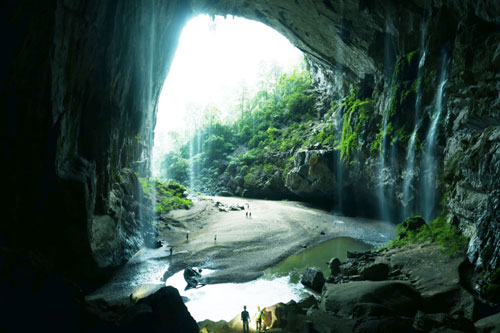
Son Doong - the world's largest cave has unique values of landscapes, geology and geomorphology (Photo: Oxalis)
Work of management and protection of the world heritage site is regarded as a leading task, therefore, after being recognized as a the world natural heritage in 2003 and 2015, the Provincial People's Committee directed the Management Board of the Phong Nha - Ke Bang National Park and related agencies to strengthen measures to prevent infringements on forest resources; mobilize all resources to patrol and protect the forest, establish a team to prevent forest fire at the villages and hamlets.
Many tourism products have been diversified with many different tours of cave expedition, ecological tourism, culture - history, adventure, farmstay, homestay, trekking, zipline, etc, especially type of environmentally-friendly tourism has attracted a large number of tourists, helping create stable jobs and incomes for people in buffer zone.
From 2003 to 2016, the Phong Nha - Ke Bang National Park welcomed nearly 5,738,756 tourists (including 399,239 foreigners) with a total turnover of VND465,946 billion. Especially, the total number of tourists to the heritage site in the first quarter of 2017 was 80,524 tourists (including 63,558 domestic tourists and 16,966 international tourists), reaching a total turnover of over VND15.3 billion.
Besides, in order to preserve the heritage's values, the environmental impact evaluation at the routes and tourist sites has regularly implemented and made a periodic report every six months. Tourism business establishments have also planned to collect and treat wastes, aiming to minimize the spread of environmental pollutants.
In addition, the Park's Management Board has coordinated with the Institute of Geology, the Institute of Geology and Minerals, the Institude of Chemistry to study geology and cave environmental factor in order to support for the heritage conservation; coordinated with the British Royal Cave Association to conduct surveys of 311 caves in the national park with a total length of over 200km. After the surveys, many caves have been discovered with the values of landscapes, geology and geomorphology such as Son Doong - the world's largest cave, Thien Duong Cave - the Asia's longest dry cave.
Work of wildlife care and rescue has been well implemented with rate of successful rescue of 92%. From October of 2002 to 2016, the national Park received more than 1,000 wildlife animals under 46 species (inlcuding 20 species listed in the Red Book of Vietnam and 25 species in the endangered, precious, and rare list issued by the Government at Decree No.32/2006/ND-CP); successfully rescued more than 800 individuals and released nearly 600 individuals into the natural environment; transferred 110 individuals to the rescue center and other functional agencies. In the first quarter of 2017, 36 wildlife species were collected, including 20 in the rescue zone and 16 in the rehabilitation zone.
According to statistics, Phong Nha-Ke Bang National Park currently has over 2,951 species of wild plants belonging to 1,006 genera, 198 families, 62 orders, 11 classes, 6 branches (including 112 species listed in the Red Book of Vietnam, 39 species in Decree No.32/2006/ND-CP, 121 species in the IUCN Red List). There are more than 1,394 species of wild animals belonging to 835 species, 289 families, 66 orders, 12 classes, 4 branches (including 83 of them listed in the Vietnam Red Book and 68 species listed in Decree 32/2006/ND-CP, 26 species listed in Decree No.160, 110 species listed in the IUCN Red List and 55 species listed in CITES appendices).
In addtion, in order to preserve values of the heritage and develop sustainable tourism in the scope of respecting outstanding universal value, minimizing the negative impacts on Phong Nha - Ke Bang National Park resources, since 2010, the Provincial People's Committee has approved the master plan for sustainable tourism development in Phong Nha-Ke Bang National Park in the period of 2010-2020 and vision to 2025 according to Decision No. 2822/QD-UBND dated November 01st, 2010.
On February, 2015, the Prime Minister issued Decision No.209/QD-TTg on approving a master development plan for Phong Nha-Ke Bang National Park. At present, Phong Nha - Ke Bang National Park is approved the policy for construction of the master plan for conservation, embellishments and promotion of national relic values, especially Phong Nha - Ke Bang National Park for 2016-2025 period and vision to 2035.
Besides, the province is setting up the master plan for biodiversity conservation of Quang Binh to 2020 and vision to 2030, of which the National Park is a key biodiversity site that will provide important solutions for conservation and promotion of the values of the World Natural Heritage.
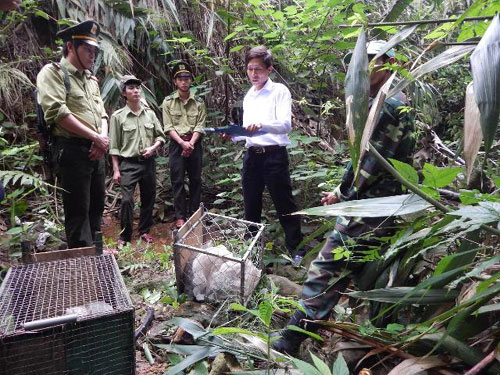
Many rare and precious animals have been successfully received and rescued by the functional forces and released into the nature (Photo: Phong Nha - Ke Bang National Park)
However, the conservation of heritage values has met many difficulties and challenges such as the population in the buffer zone communes is crowded with a low educational level, their awareness of forest protection and development law is limited; low cultivated land, the lack of stable jobs, low income, forest-based habits have not changed significantly; the investment in propaganda, conservation, research and wildlife rescue activities is still low, facilities for wildlife rescue don't meet the actual needs of rescue work. Along with abnormal changes in climate, floods and droughts leading to landslides, forest fires, seriously affecting to the ecological system, the growth of fauna and flora and the natural structures of the caves. The invasions of exotic species is the cause of loss of biodiversity, affecting the development of the ecosystem.
In the coming time, the province will continue directing relevant agencies to strengthen work of forest patrol and protection, prevent and handle hunting and trapping of wildlife, attach importance to sensitive areas and communes along the Vietnam - Laos border; apply professional measures to catch up the situation in the localities to promptly handle forest law violation; evaluate the impact of tourism activities on some caves in Phong Nha - Ke Bang National Park; implement native plant breeding to support species conservation and wildlife rescue into the natural environment; build a marketing strategy for the 2016-2020 period, organize some tourism promotion conferences in the provinces and cities across the country and some potential markets in the region; speed up propaganda on the media and television channels of the world, pay attention to the potential tourism markets.
Apart from improving the quality of existing tourism products, the province will conduct a survey to exploit the type of cave exploration tourism associated with cultural and historical valued in order to further diversify unique tourism products of Phong Nha - Ke Bang National Park; cooperate with UNESCO and other international organizations to build and strengthen the heritage management capacity through participation in the international workshop programme and receive voluntary experts as well as call for the conservation projects in Phong Nha - Ke Bang National Park.
By Nhu Y
(Source: Quang Binh Portal)


